ElevenLabs vs Descript 2026: which is better?
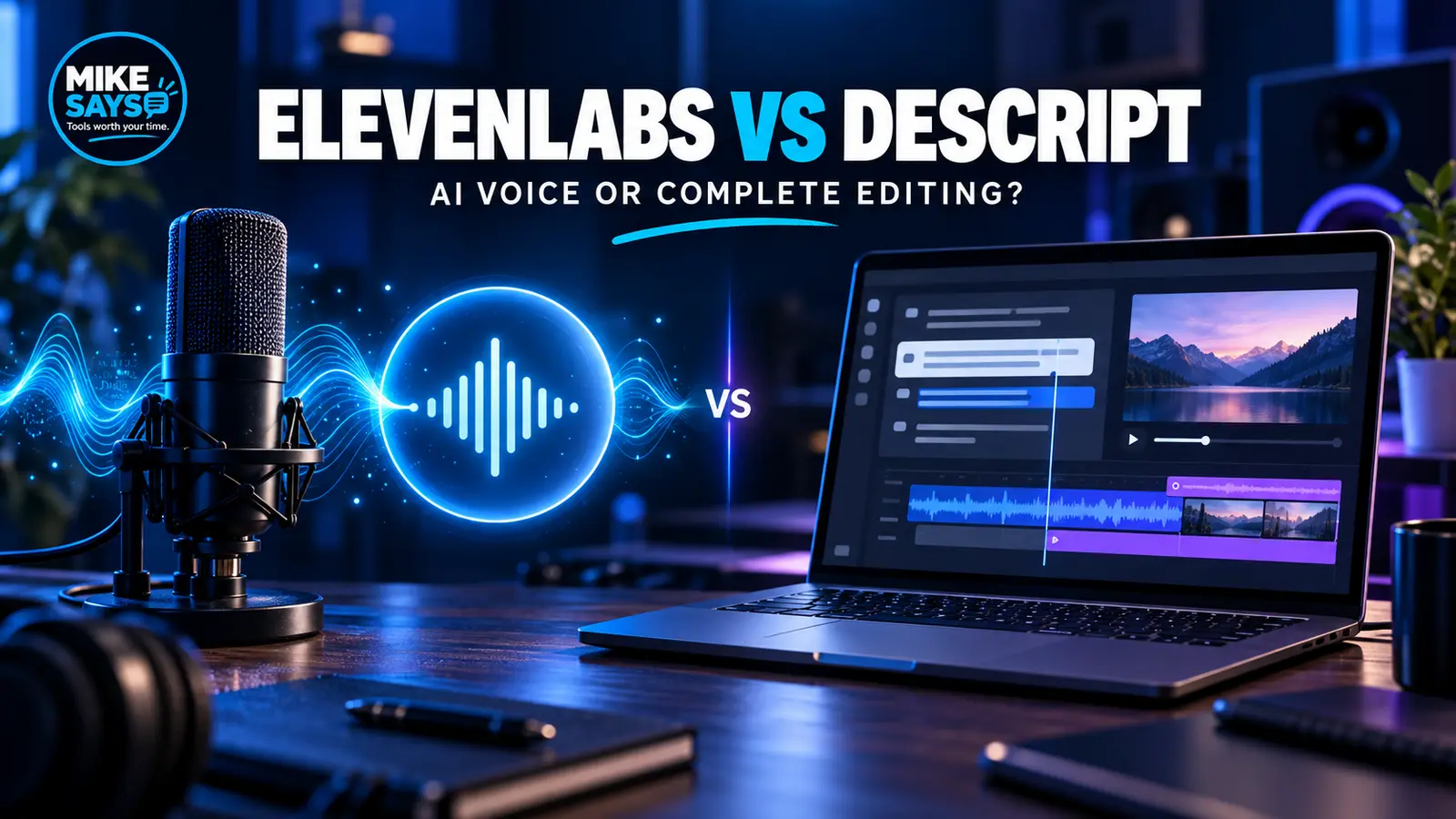
ElevenLabs vs Descript is really a choice between specialist AI audio and an all-in-one editor. ElevenLabs is my pick for voice quality, cloning, dubbing and APIs. Descript is the better fit when you want to record, transcribe and edit a podcast or video by changing the text.
Mike Says is an ElevenLabs affiliate and ElevenAPI Partner, with no commercial relationship with Descript. A qualifying ElevenLabs purchase through a labelled link may earn me commission at no extra cost to you.
Quick verdict
Choose ElevenLabs for generated speech, cloned voices, audio localisation and developer access. Choose Descript for a single workspace that records, transcribes, edits and publishes spoken-word audio and video.
Ad · Try ElevenLabs free →At a glance
| Category | ElevenLabs | Descript |
|---|---|---|
| Core strength | AI voice and audio generation | Transcript-based audio and video editing |
| Free plan | 10,000 credits/month | 60 media minutes/month |
| Paid entry | Starter at $6/month | Hobbyist at $16 annual or $24 monthly |
| Voice cloning | Instant and professional options | Custom clones in AI Speech |
| Video editing | Generation and Studio tools | Full editor with 1080p or 4K export by plan |
| API | Broad audio and agent APIs | Editing API and MCP |
1. AI voices
ElevenLabs is built around speech generation. The platform offers a large voice library, expressive models, instant and professional voice cloning, speech to speech and model choices that trade output quality against latency and cost.
Descript includes AI Speech with stock voices and custom clones. Its most useful trick is Regenerate, which can repair a spoken section so it matches the surrounding recording. For podcasters correcting a line, that is practical. For a large narrated project, ElevenLabs gives you more specialist controls and a wider voice ecosystem.
Winner: ElevenLabs.
2. Editing workflow
Descript turns recorded audio and video into an editable transcript. Delete words in the text and the media changes with it. It also includes tools for filler-word removal, captions, clips, screen recording, Studio Sound and collaborative review.
ElevenLabs Studio can handle long-form audio and video work, but it is centred on generating and arranging synthetic media. It does not replace Descript's full record-to-edit workflow for a podcast interview or talking-head video.
Winner: Descript.
3. Pricing
ElevenLabs Free includes 10,000 credits. Starter costs $6 per month with 30,000 credits, commercial use and instant voice cloning. Creator costs $22 per month with 121,000 credits and professional voice cloning, with the first month currently listed at $11.
Descript's Hobbyist plan is shown at $16 per person per month with annual billing or $24 monthly. It includes 10 media hours, 400 AI credits and 1080p watermark-free export. Creator is $24 annually or $35 monthly with 30 media hours, 800 AI credits and 4K export. Business is $50 annually or $65 monthly with 40 media hours and 1,500 AI credits.
Value depends on scope. ElevenLabs costs less when speech creation is the job. Descript can replace several separate recording and editing tools.
4. Transcription and cleanup
Descript automatically transcribes imported and recorded media and supports 25 languages on its pricing comparison. The transcript becomes the editor, so correction and cutting sit in one process.
ElevenLabs Speech to Text is available through the platform and API, with credits charged per minute. It is well suited to applications and audio pipelines, but Descript's editing experience gives it the edge for human-led post-production.
Winner: Descript for creators editing recordings; ElevenLabs for programmable speech workflows.
5. Dubbing and localisation
ElevenLabs Dubbing v2 supports 90+ languages and accents and automatically carries the speaker's identity, pitch and tone into the target language. Automatic dubbing and the more editable Dubbing Studio sit alongside API access.
Descript's Business plan includes translation and dubbing in 30+ languages with proofreading. It is appealing when localisation is one step inside a wider video edit.
Winner: ElevenLabs for dedicated dubbing and language range.
6. Team and developer needs
Descript is easy to understand as a shared production room. Higher plans add team scale, Brand Studio, priority support and more media capacity. Its API and MCP options extend editing into technical workflows.
ElevenLabs offers REST APIs plus official Python and TypeScript SDKs across speech, transcription, dubbing, music, sound effects and agents. For a product team putting audio inside software, it is the more complete developer platform.
Winner: Descript for editorial teams, ElevenLabs for product development.
Pros and cons
ElevenLabs pros: specialist voice quality, broad voice library, accessible cloning, dubbing across 90+ languages, large API surface and lower paid entry.
ElevenLabs cons: shared credits take some planning and it is not a complete podcast or video editor.
Descript pros: record, transcribe and edit in one place, excellent spoken-word workflow, useful repair tools, captions and team features.
Descript cons: higher starting price and less focus on large-scale synthetic voice production.
Which should you buy?
Buy ElevenLabs when the voice itself is central to the project, you need dubbing, you want to clone a voice, or you are building an audio feature.
Buy Descript when you record podcasts, interviews, tutorials or presentations and want to edit the finished media as quickly as a document.
My pick for AI voice work: ElevenLabs
Start with one real script on the free plan, then move to Starter only when you need commercial use or instant cloning.
Ad · Try ElevenLabs free →Affiliate link · I may earn commission from a qualifying purchase at no extra cost to you.